
Fine-Tuning vs RAG
Two Different Ways to Make AI Smarter

Everyone building AI applications eventually faces the same question:
Should I use Fine-Tuning or RAG?
Many teams treat them as competing approaches, but they actually solve different problems.
Let's break it down in simple terms.
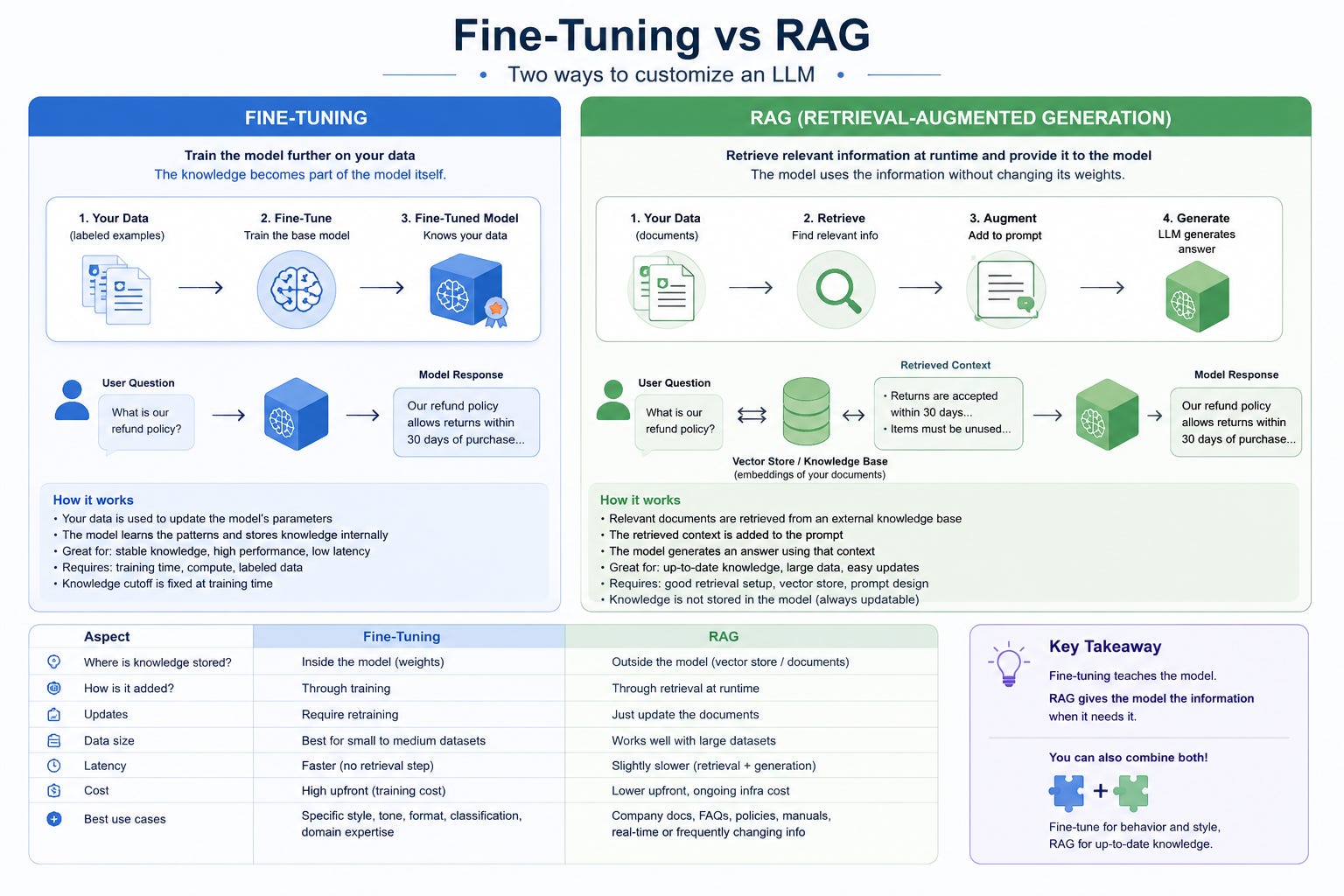
Imagine You're Hiring a New Employee
You hire a customer support representative.
There are two ways to help them answer customer questions.
Option 1: Train Them Extensively (Fine-Tuning)
You spend weeks teaching them your company's policies, products, tone, and workflows.
Over time, they memorize everything.
When a customer asks a question, they answer directly from memory.
That's exactly how Fine-Tuning works.
The model is trained on your data, and the knowledge becomes part of the model's parameters.
Advantages:
Faster responses
Consistent behavior
Learns specific styles and formats
Great for specialized tasks
Challenges:
Expensive training process
Updating knowledge requires retraining
Difficult to keep information current
Option 2: Give Them Access to a Knowledge Base (RAG)
Instead of memorizing everything, the employee searches company documents whenever a question arrives.
They find the relevant information and use it to answer.
That's Retrieval-Augmented Generation (RAG).
The model retrieves relevant documents from a knowledge base and uses them as context before generating a response.
Advantages:
Always uses the latest information
Easy to update
Scales to massive knowledge bases
No retraining required
Challenges:
Additional retrieval step
Depends on document quality
Requires good search infrastructure
The Core Difference
A simple rule:
Fine-Tuning changes the model.
RAG changes the information available to the model.
Think of it this way:
Fine-Tuning = Learning
RAG = Looking up information
When Should You Use Fine-Tuning?
Fine-Tuning is ideal when you want the model to learn:
A specific writing style
Company tone of voice
Structured output formats
Classification tasks
Domain-specific reasoning patterns
Examples:
Legal document drafting
Medical coding assistance
Brand-specific content generation
Customer support tone customization
When Should You Use RAG?
RAG shines when information changes frequently.
Examples:
Internal company documentation
Product manuals
Knowledge bases
FAQs
Research papers
Financial reports
News and current events
If your information changes weekly or daily, RAG is usually the better choice.
Why the Best AI Products Use Both
The most advanced AI systems don't choose between Fine-Tuning and RAG.
They combine them.
Fine-Tuning teaches the model:
How to behave
How to communicate
How to reason for specific tasks
RAG provides:
Current information
Company knowledge
Dynamic context
This combination gives you:
Consistent behavior
Up-to-date knowledge
Better accuracy
Lower hallucination rates
Final Takeaway
If you remember only one thing from this newsletter, remember this:
Fine-Tuning teaches the AI.
RAG informs the AI.
One changes what the model knows.
The other changes what the model can access.
And in modern AI applications, the strongest systems leverage both.
The future isn't Fine-Tuning vs RAG.
It's Fine-Tuning + RAG.